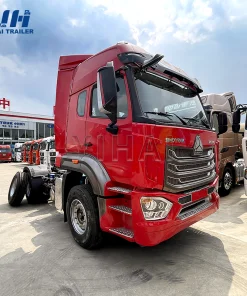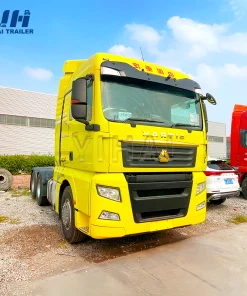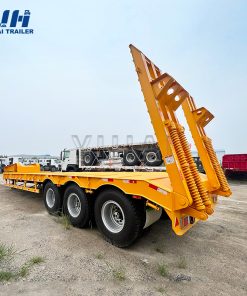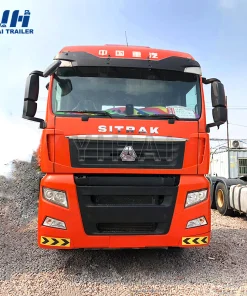
YIHAI Series
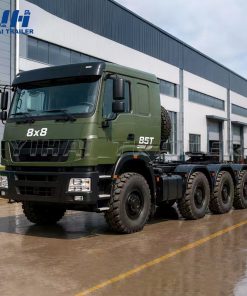
410HP 6×4 Heavy-Duty Mining Tractor Truck
| Fuel Type: Diesel | Engine: D6CA3H, Turbocharged | Axles: 3 | Tires: 12.00R24-20PR |
6×4
| Parameter | Specification |
|---|---|
| Condition | New |
| Brand Name | YIHAI |
| Market Segment | Mining, Logistics |
| Fuel Type | Diesel |
| Fifth-wheel Load Capacity (min) | 70 T |
| Drive Configuration & Drivetrain | 6×4, Equipped with Differential Lock, Left-Hand Drive (Lhd) |
| Engine Power | 410 hp |
| Transmission Type | Manual: 10 Forward, 2 Reverse Gears |
| Engine Model | D6CA3H, Four-stroke, Water-cooled, Turbocharged, 12920 cm³ |
| Wheelbase | 4600 mm |
| Axles | 3 |
| Ground Clearance (under axle) | 280 mm |
| Tire | 12.00R24-20PR |
| Overall Dimensions (L×W×H) | 6888 × 2495 × 3200 mm |
| Fifth-wheel Coupling Kingpin Diameter,Height | 3.5 inch, 1300 mm |
| Height with Roof Spoiler | 3800 mm |
| Fuel Tank Capacity | 400 L |
| Cab | Airbag, Seat Belts, Sleeper Berth, Audio System, Heating & Air-conditioning system |
| Seat | 2 Persons |
| After-Sales Service | Support |
FAQ Of Tractor Truck
What is a Tractor Truck?
A tractor truck, also known as a semi-tractor or haulage tractor, is a commercial vehicle designed to pull one or more trailers or semi-trailers. Unlike a rigid truck that carries cargo on its own chassis, a tractor truck does not have a fixed cargo body. Its primary function is to provide powerful traction to tow loaded trailers, which may carry containers, refrigerated goods, heavy machinery, etc. Key components include the cab, engine, transmission, chassis, and the fifth wheel coupling, which is the distinctive device that connects to the trailer and allows for easy attachment and detachment.
What is the difference between a tractor truck and a regular truck?
Structure: A tractor truck has no permanent cargo area on its own chassis; it must be coupled with a trailer to transport goods. In contrast, a regular truck (e.g., a box truck) has the cab and cargo body integrated on the same chassis, forming a single, self-contained unit.
Flexibility: A tractor truck can quickly swap trailers to suit different cargo types (e.g., refrigerated, flatbed, tanker) without needing to unload the tractor. A regular truck is fixed to its body and cannot change its cargo type readily.
Maneuverability: Because of the articulation, tractor-trailer combinations have a longer turning radius but are more adaptable for terminal operations.
What are the main advantages of using a tractor truck?
High flexibility: The tractor can detach from one trailer and attach to another in minutes, enabling multimodal or multi-commodity transport within a single workday. For example, it can pull a refrigerated trailer in the morning and a flatbed trailer in the afternoon.
Efficient loading/unloading: Trailers can be pre-loaded or pre-unloaded while the tractor is used for other trips, reducing downtime.
Cost-effectiveness: The tractor represents the expensive power unit; trailers are relatively cheaper, so a fleet can own more trailers than tractors, optimizing asset utilization.